
AMERICANIZED | Feature Script
Director/Writer : Erica Eng
Language: English
Genre: Coming of Age, Sports Drama
Seeking: Producer and/or Production Company looking for scripts to produce.
Logline: In 2000s Oakland, a Chinese American basketball player fights to earn her place on the high school team, only to lose herself along the way.
Synopsis: In 2000s Oakland, 16-year-old basketball player Erin struggles to find her place after costing her all-Asian summer league team the finals. Cast out, she joins her high school’s championship team — but her ego takes a hit going from starter on her old team to benchwarmer on her new one. As she navigates rivalries, friendships, and family responsibilities, Erin discovers what it truly means to belong both on and off the court.
AMERICANIZED LOOK BOOK
(click image to expand + left and right arrows to scroll)

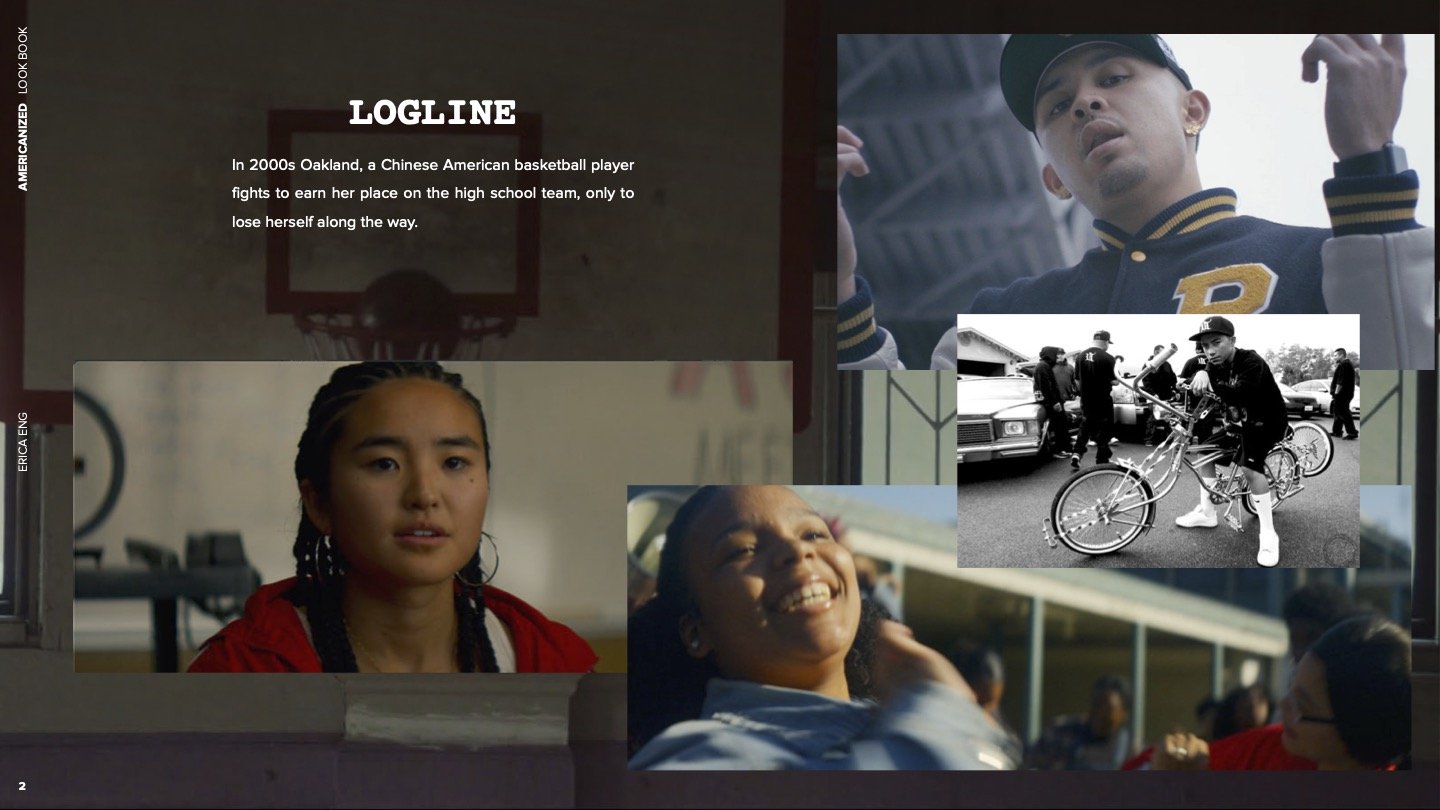
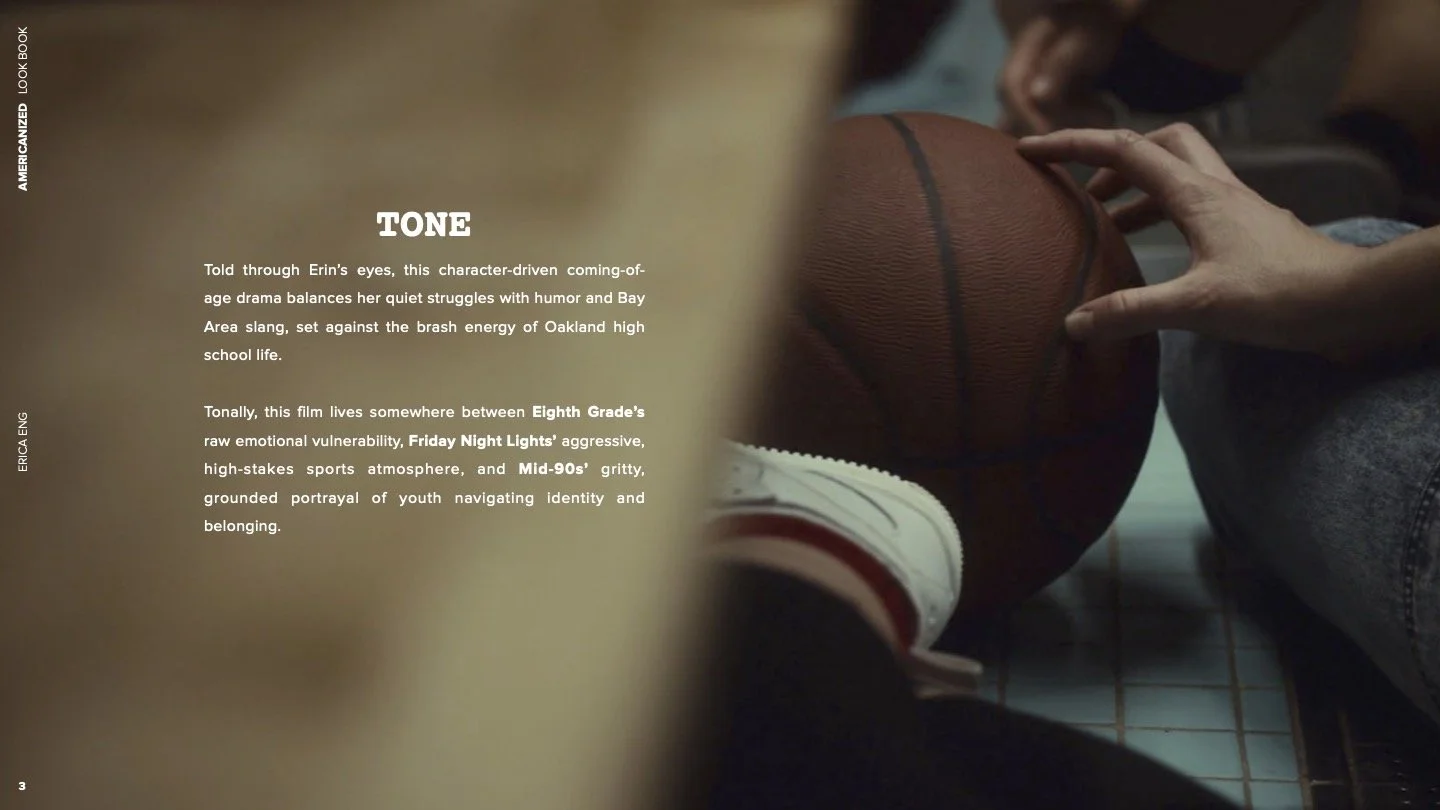


Summary:Set in 2000s Oakland, “Americanized” follows Erin, a 16-year-old Chinese American girl with baller swagger who plays on an elite Asian League team. But even as a starter, tension brews between her and her teammates as she struggles to gain their respect. During a high-stakes tournament, Erin’s need to prove herself takes over, and a reckless play costs her team a spot in the finals. Fed up, her teammates turn against her and kick her off the team.
At home, things are no easier. Erin discovers that her room has been given to her grandmother, Nee Nee, who has moved in with the family after wandering off as her Alzheimer’s worsens. As her parents quietly struggle to manage it all, Erin is left feeling unseen and displaced, forced to sleep on the couch.
At school, Erin hangs with the Asian clique, mostly to be with David, her childhood friend and crush. A rising basketball star himself, David warns Erin that the Skyline High School team are state champions and that it won’t be easy for her. Determined, Erin tries out anyway and earns a spot, quickly realizing she has much to prove – once a starter, now a benchwarmer. Luckily, Erin strikes a bond with Steph, a former second-string player who shows her the ropes.
With a new season underway, the Skyline team experiences a fall from grace after entering a losing streak. Erin struggles to find her footing on the team, and to make matters worse, the team begins blaming the new players for their losses. With Steph’s guidance and her own determination to prove herself, Erin pushes herself in training in hopes of earning their respect. As her bond with Steph grows stronger, Erin begins spending more time with her teammates outside of school, ignoring David and her Asian clique of friends.
Back at home, Erin’s parents are forced to work long hours, leaving her to care for her grandmother. Erin struggles to choose between her growing friendship with the team and her responsibilities at home. After Nee Nee sneaks out of the house and suffers a dangerous fall, Erin tries to make amends. During a trip to Chinatown, Nee Nee is confronted with her own feelings of displacement and questions of belonging, deepening their bond.
Now back on track, Skyline hits a winning streak. As Erin’s confidence grows on the court, her coach takes notice and begins moving her into the starting lineup, replacing Steph. As Erin grows closer to the team – even cornrowing her hair to match them – Steph’s resentment builds.
During the finals, Steph makes a few risky plays that cause the team to lose its lead. With seconds left, Coach subs Erin in for Steph, and Erin sinks the game-winning shot – a moment of glory that leaves Steph feeling slighted. Tensions finally explode when Steph confronts Erin after the game, leading to a fight between the friends and leaving Erin with a black eye.
The next day, Erin takes out her cornrows and returns to herself. Worried about being ostracized, she is surprised when her teammates respect her for standing up for herself in the fight, giving Erin the acceptance she has been craving.
In the end, Erin is sad to learn that Nee Nee has moved into a care facility, but visiting her shows Erin that she, too, has found a place to belong. At the team’s championship dinner, Erin and Steph share a heart-to-heart and reach a place of mutual respect. Erin is awarded the team’s “Clutch” honor, and the team takes a photo as champions.
Artist Statement: Growing up as a fifth-generation Chinese American meant growing up very “American.” I had a hard time understanding my Chinese identity because my family didn’t speak the language, cook the food, or practice many of the traditions. I felt so separated from the culture that I didn’t feel “Chinese” - I just felt lost. To some, “Americanized” means to adapt to White-American culture; but for me growing up in Oakland, it meant being a part of hip-hop and urban American culture.
I’m passionate about telling this story because there’s a huge lack of sports films centered around women of color. As a storyteller, I want to fill that gap by showcasing female sports in a way that we haven’t seen before – raw, intense, and unapologetic, without being softened by romance or comedy. I want audiences to feel the gruffness of the game, and the grit in the female athletes as they push themselves on the court.
Women’s basketball is on the rise, with new teams forming and the sport capturing a wider audience than ever before, fueled by stars like Caitlin Clark. The New York Times reports that this popularity isn’t just amongst a female fan base, but amongst men and young boys, too. So now is the time to tell this story because there’s an audience and a hunger for it. We’re craving stories that reflect intensity, ambition, and identity – especially for young women who haven’t yet seen themselves centered this way
And as our world becomes more diverse, so do our struggles with identity. I wrote this film because I felt caught between two worlds – not feeling Chinese enough, yet not feeling fully American.
After releasing the short film, I realized this is no longer just my story – this is everyone’s story. Whether they were Puerto Rican / Mexican, or Trinidadian / American, I was deeply moved when people across many cultures told me they resonated with the same feelings I struggled with as a Chinese American. This story is so relevant and relatable that the film continues to be shown in high schools across the country as part of their curriculum. My goal has always been to tell a story that makes you feel – regardless of your age or cultural background.
I’m the one to tell this story because this is my story. As the only Asian player on an all-Black team, I want to showcase my experiences from the inside – with nuance, complexity, and humor – rather than as an outsider explaining diversity. I think it’ll be powerful to show women of color navigating a space as themselves, where conflicts arise from ego rather than race, and diversity is simply the norm. I want audiences to see and experience how I grew up in Oakland – where social dynamics weren’t centered around whiteness. Instead, we focused on the opposite: how can we be more culturally proud, and rep where we’re from? The dilemma I faced as a 5th-generation Chinese American is that I didn’t know where I was from… besides Oakland.
At its core, Americanized is a story about acceptance. While it’s deeply rooted in my own personal experience, the emotional throughline of struggling to find your sense of self is universal. Through this film, I aim to fill the gap in sports stories and portray female athletes in a way we’ve never seen before – and I want audiences to walk away feeling seen, inspired, and empowered to embrace who they truly are.